
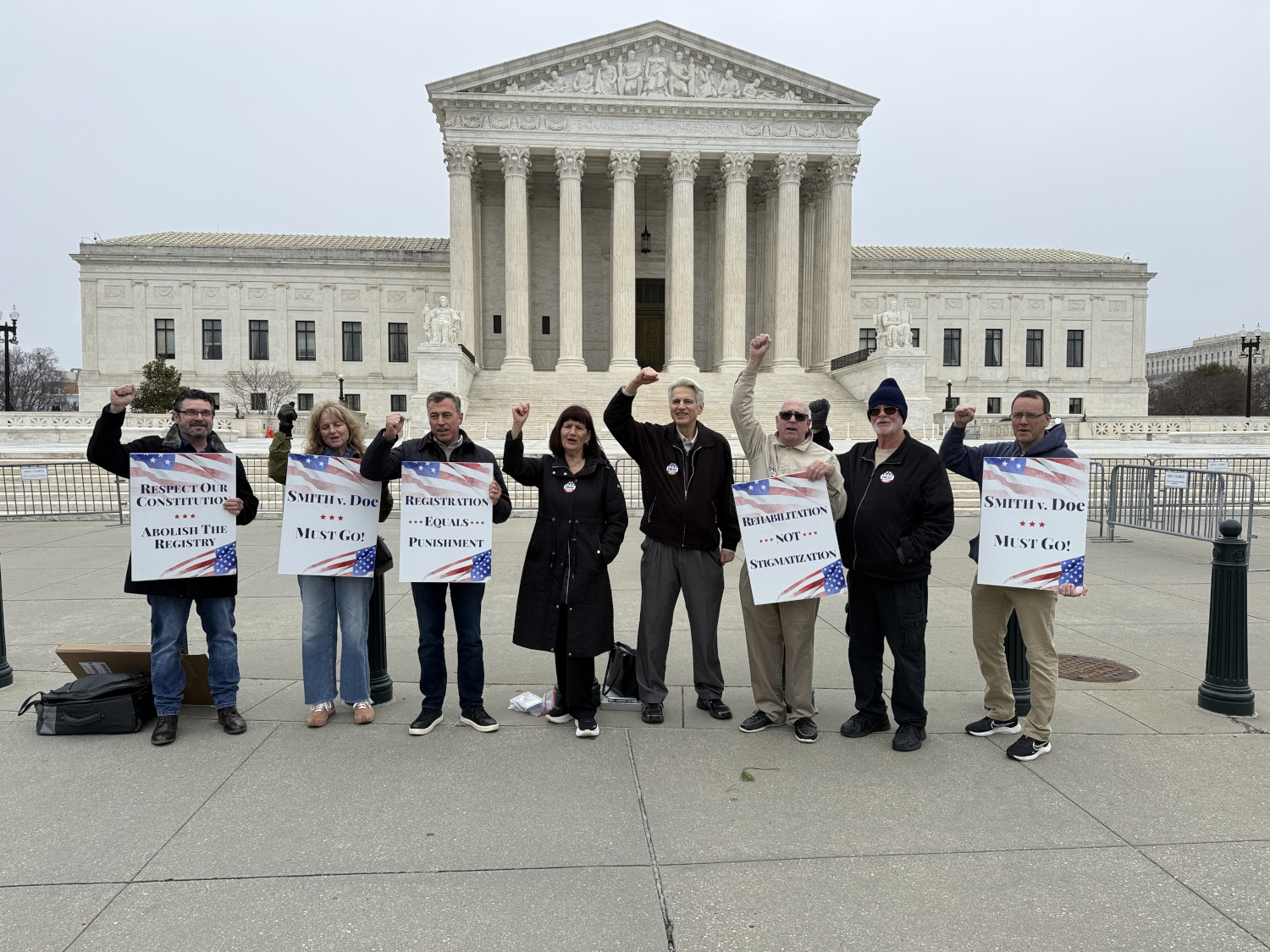
Registrants and family members conducted a vigil today in Washington, D.C., near the U.S. Supreme Court. The participants held printed signs with messages such as “Smith v. Doe Must Go” and “Registration is Punishment.”
The sole speaker at the event was civil rights attorney Janice Bellucci. In her speech, she stated that the Court made a “terrible mistake” in 2003 when they issued the Smith v. Doe decision which erroneously stated that registration is not punishment. Bellucci also demanded that the Court overturn its decision immediately.
Following Bellucci’s speech, the participants chanted “Smith v. Doe” must go and raised their right fists. Vigil participants are current residents of Florida, Maryland, Iowa and California. Two of the participants, a married couple, plan to move permanently from Florida due to recent and anticipated changes in state laws.
There were no arrests or acts of violence during today’s vigil. The vigil will be held again next year near or on March 5, 2027.
The vigil was video recorded and can be viewed below or at this link.
What an amazing experience it is to stand in front of the Supreme Court, raising our hands in defiance, chanting “Smith vs Doe Must Go!”
Coming to the Supreme Court with others in ACSOL and other pro-registrant groups gave me hope and a feeling of unity.
Our goal in coming here was not of course to expect the judges to listen today. It was to encourage you as you see us united to fight for justice around the nation, and over time change legal momentum and change society’s attitudes, which will free us from the registry someday. Eliminating the registry is not a magical instant thing, it is a long-term process.
Hey, if other people groups like gays, blacks, Native Americans, and many others can think long-term and work together to change things, we registrants can too!
Please consider planning to join us next year.
Thank you to everyone who attended and made their voice heard!!
There may not have been a great number there, but it only takes a spark in the right place to create a blaze of fire!!
Thank you to all!!
Thank you for doing this and I hope the people who can attend grows. Your efforts are so appreciated and mean a lot to so, so, so many.
Registration is punishment and the response is either a tension-building fish bowl or pillory if not vigilantism. Registration serves no valid purpose. It should go.
And just yesterday, the US Congress, the very people who write and vote in the level of punish handed out to those who are convicted of sex crimes, voted 357 to 95 to block exposure of which member’s are paying out of the slush fund specifically set up pay off and to silence THEIR victims and accusers so as keep it quiet so they don’t have to face the same punishment people like us have suffered.
The Vote Is The Answer
Written By Quiet too long 03/08/2026
When an institution contains unknown levels of human misconduct, every member becomes vulnerable to the possibility of being destroyed by registry‑restrictions — the kind of civil labeling that will erase constitutional protections and collapse a person’s world. That vulnerability creates a shared incentive to block transparency, because revealing one case could trigger scrutiny of others, even by association or by knowledge alone. The result is a collective vote to maintain secrecy against all the compelling obstacles that current laws are supposed to provide, not because all are guilty, but because none can be certain who might be implicated or swept into the registry fallout.
And lawmakers’ own actions show that they understand how destructive a registered life can be: when the possibility of public labeling touches their institution, they move quickly to prevent it. They know that once someone is publicly labeled in civil matters involving sexuality or human behavior, the consequences include job loss, family strain, housing bans, travel restrictions, proximity constraints, religious restraints, reporting requirements, humiliation, and social or communal isolation ( Administrative De-personing )
— the same outcomes the registry imposes on individuals, and everyone connected or is social to them.
The structure is unmistakable: protection inward, exposure outward, and no constitutional protections for those on the outside. Lawmakers demonstrate an understanding of the destructive nature of a registered life by voting to block exposure within their own ranks,
as seen in the 357‑to‑95 vote regarding taxpayer‑funded settlements.
Ultimately, the system protects those in power while enforcing exposure on those outside it, creating a form of communal isolation that reinforces the need for secrecy.
Disclaimer:
This analysis reflects a structural and constitutional critique of public policy and institutional incentives. It does not allege wrongdoing by any specific individual, official, or agency, nor does it assert knowledge of personal conduct, guilt, or involvement in any misconduct. All references to “exposure,” “registry‑ consequences,” or institutional behavior describe extreme legal mechanisms and publicly observable patterns within civil regulatory systems. This commentary is offered for public discussion and educational purposes only and should not be interpreted as legal advice or as an accusation against any person or entity.